
01 Try it
The same input goes to Jev, to OpenAI Decisions and to claude-opus-5 at the same moment, and both are timed here in your browser. The LLM runs as an agent in your own Loopfour workspace (the first race creates agents named [jev-race] …), so it is billed by Loopfour, a few cents per race at most.
Enter your Jev API key in the .
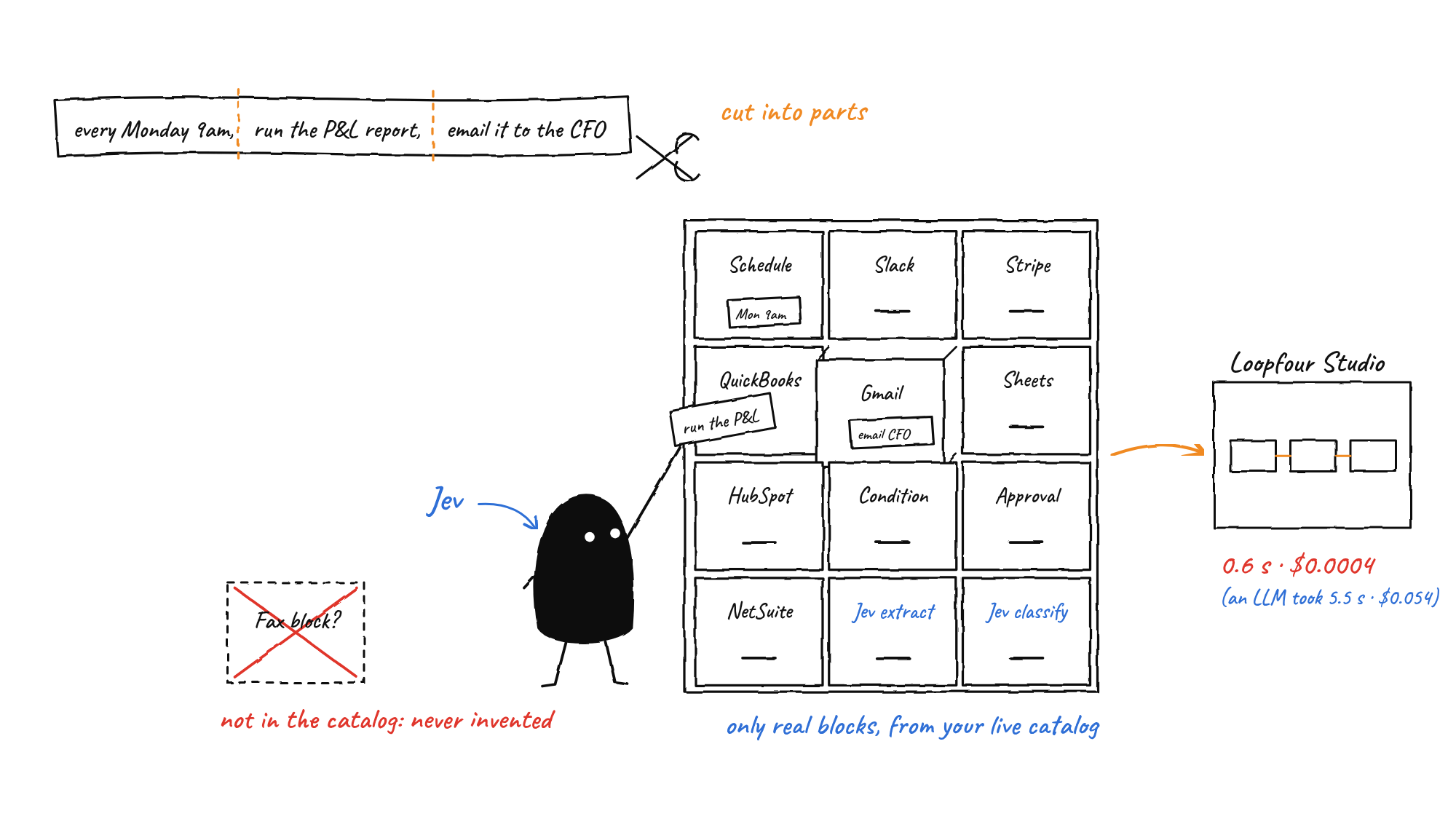
Describe a workflow in plain language. Jev maps every part of it to a Loopfour block, choosing only from your workspace's live block catalog, or recognizes one of Loopfour's templates and recreates it exactly. The workflow is then created in Studio through the Loopfour Workflows API (POST /workflows plus the canvas). Extraction and classification steps run on Jev; the AI Agent is only used for open-ended work.
Enter your Loopfour API key in the .
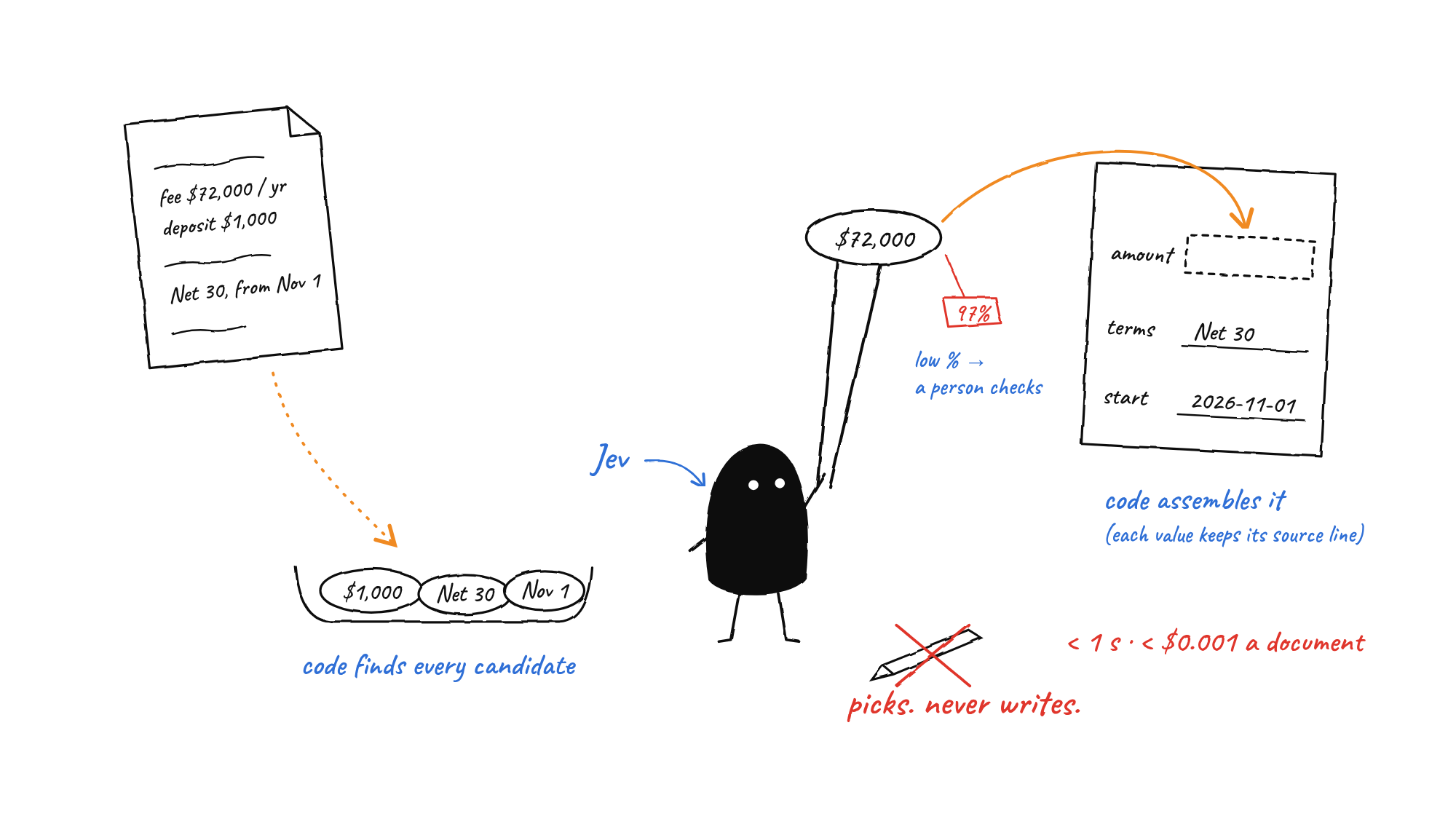
Turn any document into JSON with the fields you define, like the AI Agent block's Output Schema, but every value is picked by Jev from candidates found in the text and copied verbatim. Nothing is generated, so nothing can be invented.
Enter your Jev API key in the .
Assign a document to your labels with calibrated probabilities. One label (with a check that it really applies, so "none fits" is possible) or several at once. Low-confidence results are flagged for review instead of guessed.
Enter your Jev API key in the .
Every workflow template in Loopfour Studio, read live from your workspace. Pick one and Jev rebuilds it from plain language alone: it recognizes which template the text describes (checked against all 29, plus a second yes/no check) and recreates exactly its trigger and steps, filling variables like Slack channels from your words. In our tests all 29 templates were recreated correctly from both their description and a bare list of their steps (58/58), and no ordinary description was mistaken for a template.
Enter your Loopfour API key in the .
02 Why Jev
Why Jev inside Loopfour Studio
Most steps an LLM does in a finance workflow are not writing: they are decisions. Which block does this request need? Which amount is the total? Is this email an invoice or a receipt? Jev (TypeSafe's System One model) answers exactly those typed questions, with calibrated probabilities, in milliseconds, without generating text.
What this site implements, measured results, and what changes for Studio users
What this site implements
Plain language to a Studio workflow: every part of the description is classified against what each block does, using your workspace's live block catalog, so actions and fields are never invented; descriptions of Loopfour's own templates are recreated exactly. Workflows are created through the Loopfour Workflows API.
POST /api/extract: a JSON Schema in, JSON out. Values are found in the document and picked by Jev, then copied verbatim, each with its source line and a confidence.
POST /api/classify: labels in, the best label (or several) out, with a check that it really applies and a review flag when Jev is unsure.
Measured in this project
| Task | Jev | LLM (claude-opus-5) |
|---|---|---|
| Build a workflow from a description (5 test descriptions, same catalog, same scoring) | 0.64 s · $0.00042, 5/5 correct | 5.52 s · $0.054, 5/5 correct |
| Extract 11 billing fields (incl. line items) from the sample order form (3 runs) | 0.47 s · $0.00049, 11/11 correct | 5.00 s · $0.0154, 11/11 correct |
| Classify the 4 sample support tickets into billing / technical / sales (2 runs each) | 0.20 s · $0.000025, 8/8 correct | 2.85 s · $0.0041, 8/8 correct |
Each row ran the same inputs through Jev and through a claude-opus-5 agent on Loopfour, scored the same way, with wall-clock times and the cost Loopfour reports. Jev was 8.6× faster and 128× cheaper building workflows, 10.6× faster and 32× cheaper extracting, and 14.4× faster and 163× cheaper classifying, with the same accuracy. Studio's Copilot took 11 s to set up the billing-exceptions template. Scripts: npm run compare and npm run compare:functions.
What changes for Studio users
- Speed: workflows and extractions in under a second instead of several seconds per LLM call.
- Cost: fractions of a cent per document, so every invoice and contract can be checked, not a sample.
- Nothing invented: Jev chooses among values found in the document (or blocks in the catalog) and code copies them, so a total, a date or an action name cannot be hallucinated. Each value keeps its source for the audit trail.
- Confidence you can route on: low-confidence fields go to Studio's Approval block; the rest flows straight through.
- An LLM only for what Jev cannot settle (optional): following the cascade pattern, only answers Jev is unsure about go to Loopfour's own claude-opus-5, and its answer is kept only if it quotes the document and Jev confirms it. In our tests a memo with "the 1st of Nov. '26" escalated just that one field (2.4 s, $0.006) while a fully readable contract made no LLM call at all; values that are not in the document stay flagged instead of being invented.
- LLMs where they help: the AI Agent block stays for open-ended work (summaries, anomaly hunting); the builder only uses it when a step needs it.
Today these functions plug into any workflow through an API Request block (the builder sets it up, with your Jev key stored as the workflow secret JEV_API_KEY). Natively, they would be Studio blocks, and the Copilot could call the same block classifier before writing anything.
03 Example workflows
Workflows that use Jev extraction and classification
Describe a step that extracts fields or sorts a document into labels, and the builder adds a Jev Extraction or Jev Classification step: an API Request block that calls this site's /api/extract or /api/classify with your Jev key from the workflow secret JEV_API_KEY. No AI Agent, no LLM at run time. These prompts were checked against the live builder:
Extraction
“When a signed contract arrives, extract the customer name, annual fee, start date, billing frequency and payment terms, then create a customer in Stripe and notify #billing in Slack.”
Jev Extraction → Stripe: Create Customer → Slack: Send Message
“Extract the invoice number, vendor, total and due date from the invoice, then create a bill in QuickBooks.”
Jev Extraction → QuickBooks: Create Bill
“Extract the vendor, amount and expense category from the receipt. If the amount is over $5,000, ask cfo@acme.com for approval, then create a bill in QuickBooks.”
Jev Extraction → Condition → Approval → QuickBooks: Create Bill
“Extract the payer, amount and invoice reference from the remittance email, then notify #cash-app in Slack with the result.”
Jev Extraction → Slack: Send Message
Classification
“Classify the support ticket as billing, technical or sales, then post it to #support in Slack.”
Jev Classification → Slack: Send Message
“Classify the customer's collections reply as promise to pay, dispute, payment sent or out of office, then notify #collections in Slack.”
Jev Classification → Slack: Send Message
“Search Gmail for new emails every hour, classify them as invoice, receipt or other and add the results to a Google Sheet.”
Schedule → Gmail: Search Emails → Jev Classification → Google Sheets: Append Values
“Classify each vendor invoice as software, travel, marketing or office supplies and add a row to the Google Sheet.”
Jev Classification → Google Sheets: Append Values
04 Across Loopfour
Other parts of Loopfour where Jev works great
Loopfour's rule is deterministic workflows with AI only where it helps, "scoped and confidence-gated". Jev is that kind of AI: it answers a typed question with a calibrated probability and never writes free text. Going through all 19 case studies and the four solution pages, the same few judgments keep coming back:
Today: Signed contracts arrive from DocuSign, SignNow, HelloSign or an API, and "AI parses the terms": amounts, cadence, discounts, minimums, renewal, milestones and splits. Loopfour promises that this AI is "scoped and confidence-gated" and that "every number traces back to a clause".
With Jev: This is exactly what /api/extract does: code finds every candidate value in the contract, Jev picks the one each field asks for, and code copies it verbatim with its source line and a calibrated confidence. Ambiguous terms go to a person instead of being guessed, and a value cannot be invented.
AI infrastructure (contract to reconciliation) · Money services (contract to cash) · PropTech (lease to payment) · Accounting services (partner billing) · Estate planning (rev rec) · Health diagnostics (usage credits) · Digital signage (Salesforce to NetSuite)
Today: Payments land as lump sums with remittance "in whatever shape they arrive": Wise and bank notifications, partner remittances covering fifty invoices, short-pays with no reason. "Scoped AI parses it into structured data" and a match clears "only above the confidence threshold you choose".
With Jev: Code proposes the candidate invoices (amount, date, customer); Jev reads the memo or remittance and picks among them with a calibrated probability, which is the confidence threshold. One Noul per reason explains a short-pay (withholding tax, FX, deduction, dispute).
Cybersecurity (cash application) · Creator economy (billing and payouts) · AI infrastructure (contract to reconciliation) · Food hall (tenant billing) · Fintech ($5.6B, five rails) · Money services (contract to cash)
Today: Collection emails go out on schedule, but the replies still need reading: "manual searches through a shared inbox", disputes with "no paper trail", and "accounts that need escalation and accounts that need patience get treated identically".
With Jev: Classify every reply (promise to pay, payment sent, dispute, remittance advice, wrong contact, out of office), extract the promised date or amount, route it to the right collector, and score urgency so the dunning sequence pauses or escalates on what the customer actually said.
Cybersecurity (cash application) · Lending marketplace (loan notifications) · Money services (contract to cash) · AI infrastructure (contract to reconciliation)
Today: Invoices route to the union or non-union QuickBooks entity "based on their characteristics", opportunities are "categorized by sales team", pharmacy subsidy lines are stripped for multi-state tax, and expenses split across entities, branches and currencies.
With Jev: One Choice per record or line: the entity, the GL account (hierarchical classification handles large charts of accounts), the team, or the tax treatment, each with a confidence that sends only the unclear lines to review.
Everyset (payroll invoices) · Digital signage (Salesforce to NetSuite) · Senior living SaaS (billing) · Travel tech (month-end workbook) · Food hall (tenant billing) · HRA reimbursements
Today: Salesforce opportunities "mapped to NetSuite requirements", "HubSpot fields that don't map natively", delivery-platform stores matched to tenant contracts, vendor invoice lines matched "at the line-item level" to order forms.
With Jev: Pairing two lists whose names differ is a Choice per item over the other list, the same way the builder maps each part of a description to a block in the catalog. It runs once at setup or on every new item, and the probabilities show which pairs a person should confirm.
Digital signage (Salesforce to NetSuite) · Senior living SaaS (billing) · Food hall (tenant billing) · Healthcare tech (four-way vendor match) · Travel tech (month-end workbook)
Today: Deposition PDFs where only the first and last three pages matter, 120–180-page invoice packages checked seven ways against payroll, an estate value confirmed in a Slack reply, and exceptions that need "the right owner with everything they need attached".
With Jev: Line search finds the few lines that answer each question in a long document, so code can read the numbers and apply rules like "whichever start time is earlier". For exceptions, Jev picks the owner or queue and checks whether a note explains a variance, so reviewers start with the ones that matter.
Legal billing (depositions) · Everyset (payroll invoices) · Estate planning (rev rec) · Fintech ($5.6B, five rails) · PropTech (lease to payment) · Manufacturing (ASC 606 on Epicor)
What stays code
Rent and split calculations, ASC 606 schedules, four-way-match math, dunning schedules, ACH and postings stay deterministic rules, as they are today. Jev only answers the questions those rules need from text (which value, which invoice, which entity, which owner), and each answer is logged with its probability like any other step, so the audit trail Loopfour sells on stays intact.
Case by case: all 19 Loopfour case studies
| Case study | Where Jev fits |
|---|---|
| Legal billing (depositions) | Pick the start and end timestamps among those found in the first and last three pages (code applies "whichever is earlier"); low confidence goes to the existing Slack review. |
| Everyset (payroll invoices) | Route each invoice package to the union or non-union entity, and locate the gross, tax, workers' comp and fee lines the seven payroll checks need. |
| Healthcare tech (four-way vendor match) | Pair vendor invoice lines with order-form and pricing-calculator lines when the descriptions differ. The variance math stays rule-based, as the controller wants. |
| Estate planning (rev rec) | Read the confirmed estate value from the Slack reply at month 6 and check it is a confirmation, not an estimate, before the mid-term invoice is drafted. |
| Manufacturing (ASC 606 on Epicor) | The recognition math stays code; Jev reads the CFO's reply to the review email (approve, reject, needs changes) so posting doesn't wait on a button. |
| Health diagnostics (usage credits) | Read the tier and credit quantity from the signed HelloSign contract, and classify design-review replies as approved or changes requested. |
| Accounting services (partner billing) | Extract milestones, percentages and completion criteria from partner contracts with no standard format (one row per milestone), and classify tax one-off requests for routing. |
| Fintech ($5.6B, five rails) | Suggest the client trust account from a deposit memo, flag out-of-pattern deposits, and pick the exception queue with the reason attached. |
| Cybersecurity (cash application) | Classify inbox replies and route them to the collector, map partner remittance lines to customer invoices, spot withholding-tax short-pays, and read portal dispute reasons. |
| AI infrastructure (contract to reconciliation) | Extract amount, cadence, discounts and auto-renewal from DocuSign contracts, and match Airwallex payment references to invoices, one-to-one or one-to-many. |
| Food hall (tenant billing) | Read fee terms (percentage, minimum, common area fee, waivers) from 70 tenant contracts, and map delivery-platform store names to tenants. |
| Money services (contract to cash) | Extract setup fees, platform fees, minimums and renewal from SignNow contracts, tell volume-based from fee-based minimums, and name the client behind an ACH or wire description. |
| Creator economy (billing and payouts) | Parse each Wise notification (amount and brand) and pick the deal it pays among the open ones in Airtable. |
| HRA reimbursements | Check each employee spending line against the plan's eligible categories before the statement and ACH are built, sending unclear lines to review. |
| Digital signage (Salesforce to NetSuite) | Read contract PDFs into Salesforce fields instead of reps transcribing them, categorize opportunities by sales team, and map fields to NetSuite. |
| Senior living SaaS (billing) | Flag pharmacy subsidy line items for the tax rules, map HubSpot custom fields to NetSuite, and recognize module-addition requests that need an addendum. |
| Lending marketplace (loan notifications) | Classify borrower replies (paid, will pay on a date, dispute, hardship) to cancel or escalate the Day 1, 5 and 14 reminders, and read counter-proposal terms. |
| Travel tech (month-end workbook) | Classify Expensify lines by entity and GL account, and map Salesforce products to NetSuite items for billing and the rev rec schedule. |
| PropTech (lease to payment) | Extract rent, deposit, pet and parking fees, start date and term from the lease with ambiguous terms flagged (what /api/extract already does), and read maintenance invoices for approval. |
05 Reading